I found Justin Holcomb's article on the Dutch and Scottish streams of Reformed theology to be very helpful. You can read his article at The Resurgence or as it was reposted at Justin Taylor's website.
A book that I read last year on the subject was Jamie Smith's Letters to a Young Calvinist. Smith is a professor at Calvin College. That biographical detail alone places him somewhere within the Dutch Reformed, Kuyperian tradition. His small book discusses the streams of Reformed thought and discusses his entry into Reformed theology through the front doors of the Scottish tradition before coming to sit with the Dutch thinkers like Kuyper, Bavinck, and Berkhof. My own experience of Reformed theology has been, to this point, the opposite. I was immersed in the Dutch Reformed tradition since infancy, but in young adulthood have been drawn to those in the Scottish tradition: John Owen, Richard Baxter, Jonathan Edwards, and other Puritan figures.
For those of you who are interested, here is also a link to Holcomb's introductory article on Abraham Kuyper.

Showing posts with label History. Show all posts
Showing posts with label History. Show all posts
Thursday, September 27, 2012

Thursday, April 19, 2012
Bonnie and Clyde
Go Down Together: The True, Untold Story of Bonnie and Clyde pulls back the Hollywood gloss that has been layered thickly upon two of America's most celebrated criminals, Clyde Barrow and Bonnie Parker. Their lives were far glamorous. Together they fled from "the laws" for a significant portion of the four years that they knew each other (the only significant breaks coming when Clyde or Bonnie spent time in prison).
 Clyde Barrow was a small-time criminal turned murderer. He was not a brilliant criminal mastermind (far from it, according to Guinn's account), nor was he especially lucky as a criminal. Clyde had more failures and mishaps as a criminal than successes. Often, Clyde, with Bonnie in tow, would be forced to frantically hijack a Ford V8 automobile and race out of town.
Bonnie Parker was a sociable young woman who loved Clyde unto death. Though opportunities were available for Bonnie to escape the certain death sentence that awaited Clyde, Bonnie was committed to dying with Clyde.
My wife and I listened to the audiobook of Go Down Together and thoroughly enjoyed this tale of life on the run with Clyde Barrow and Bonnier Parker. If you're looking for some entertaining summer reading, consider picking up this Depression-era story of crime and life on the run for two of America's most recognized criminals, Bonnie and Clyde.
Go Down Together: The True, Untold Story of Bonnie and Clyde by Jeff Guinn
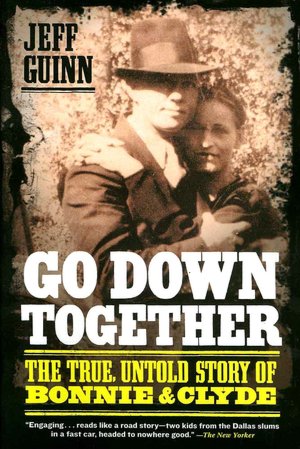 Clyde Barrow was a small-time criminal turned murderer. He was not a brilliant criminal mastermind (far from it, according to Guinn's account), nor was he especially lucky as a criminal. Clyde had more failures and mishaps as a criminal than successes. Often, Clyde, with Bonnie in tow, would be forced to frantically hijack a Ford V8 automobile and race out of town.
 Bonnie Parker was a sociable young woman who loved Clyde unto death. Though opportunities were available for Bonnie to escape the certain death sentence that awaited Clyde, Bonnie was committed to dying with Clyde.
My wife and I listened to the audiobook of Go Down Together and thoroughly enjoyed this tale of life on the run with Clyde Barrow and Bonnier Parker. If you're looking for some entertaining summer reading, consider picking up this Depression-era story of crime and life on the run for two of America's most recognized criminals, Bonnie and Clyde.
Go Down Together: The True, Untold Story of Bonnie and Clyde by Jeff Guinn
Published: 2009 by Simon & Schuster
Length: 480 pages
Purpose Statement: To tell the true and less-than-glamorous story of Clyde Barrow and Bonnie Parker.
Difficulty (out of 5): It was an audiobook... how difficult can it be to click play?
Rating (out of 10): Eight
Recommended For: People interested in history, biographies, or crime.
Cheapest Place to Buy: I received the audiobook from Audible.com as part of a free trial. A hard copy of the book can be purchased through Amazon for $6.80.
Monday, January 16, 2012
Cambodia

In the January 2012 edition of National Geographic magazine, Mark Jenkins and Lynn Johnson tell the story of landmine victims in Cambodia and the nature of the healing process of a country recently removed from war and the ever present reminders thereof. Pol Pot and the Khmer Rouge, guilty of many horrific crimes (estimates suggest he was guilty of killing over 1.5 million people between 1975 and 1979), would take children and teach them to lay, defuse, and deconstruct landmines. The country's economic and social welfare was buried beneath the cost of war-- in particular, landmines which made large areas of farm land unworkable for poor, starving Cambodians.
While Pol Pot died in 1998, and the Khmer Rouge fell apart, casualties from a war that began in the mid-1970's still happen today. Landmines buried beneath the surface of the earth are detonated by unsuspecting passer's-by. Many landmines will produce severe wounds and the amputation of limbs ("...[land mines] are designed to maim rather than kill, because an injured soldier requires the help of two or three others, reducing the enemy's forces..."), a majority of the victims are civilians ("Only 25 percent of land mine victims around the world are soldiers. The rest are civilians—boys gathering firewood, mothers sowing rice, girls herding goats.")
The article is fascinating and is well worth your time, not only for your own education but out of respect to the stories of the hardships that Cambodians have faced and continue to face today.
For readers, one possible response to this article (though you are encouraged to be more creative and think of other ways) which all are capable of is to spend some time praying for Cambodia:
- Pray for the government of Cambodia, that it might treat its citizens justly and wisely
- Pray for Cambodians, whose average per capita annual income is roughly $2000 per year
- Pray that those who have been wounded or lost family and friends in the violence might be able to forgive and instead contribute to peace and restoration in Cambodia.
- Pray for the spiritual welfare of Cambodia. It is estimated that 96% of the country are Buddhist. Pray that missionaries, through the power of the Holy Spirit, would be effective in telling Cambodians about the gospel of Jesus. Pray that many would receive Jesus and the healing he offers.
- Pray for missionaries and mission agencies that are working in Cambodia. The Christian Reformed World Relief Committee is one such agency. Pray for missionaries Rachel Brink and Rick and Edith DeGraaf. Consider supporting them financially or by e-mailing them a word of encouragement and support.
For further information on the history of Cambodia, readers can access the Encyclopedia Brittannica article as a brief introduction to the subject.
Subscribe to:
Posts (Atom)