Showing posts with label Resources. Show all posts

Wednesday, August 14, 2013

Stand to Reason: An Apologetics Ministry

Stand to Reason is an apologetics ministry that is worthy of your attention. Stand to Reason offers this description of their ministry: 
"Stand to Reason trains Christians to think more clearly about their faith and to make an even-handed, incisive, yet gracious defense for classical Christianity and classical Christian values in the public square."
Stand to Reason publishes many helpful blog posts and articles on issues related to Christianity, contemporary issues, ethics, and apologetics. My wife and I have also profited greatly from Stand to Reason's weekly broadcast hosted by Greg Koukl. Koukl, an adjunct professor in Christian apologetics at Biola University, offers articulate and winsome commentary on issues of faith and philosophy. He also fields a wide range of questions from callers. The following list shows the questions Koukl answers on the August 6, 2013 edition of the Stand to Reason podcast
  1. Is postmodernism dead?
  2. What if God didn't choose me?
  3. Can we determine the Biblical authors' intent?
  4. "Having It All" Means No Baby?
  5. How would you respond to a family member who is homosexual and getting married?
  6. Black Hebrew Israelites theology is deceptive.
  7. Unitarians Have No Heresy
  8. Redefining marriage
  9. Can we say "God is good" objectively or only subjectively?
  10. Will God save sincere believers if they aren't predestined?
  11. Is there a justification to end a pregnancy?
It's an impressive day's work to intelligently address such a wide range of important issues. I trust you will also benefit from this fantastic ministry as I have. 

Greg Koukl, host of the Stand to Reason's weekly broadcast


Thursday, April 18, 2013

Evernote

This past week I was introduced to the program Evernote. The capabilities of this program will change the way I file information, organize my research, and prepare for sermons. Evernote, which is available online as a free download, allows you to clip, save, and search photos, videos, and articles. Here's a look at a couple of the coolest features of Evernote: 

If you are using Firefox as your web browser you will have the Evernote helper in the toolbar (the elephant head in the top right corner). 

 
When you find an article or webpage that you would like to save for future reference simply click the Evernote helper. In reading the New York Times I found an article on a recent federal court ruling concerning the Morning-After Pill. The Evernote web clipper tool will pop up and allow you to edit the title of your article, add keyword tags, and further notation. 


When you log into Evernote you can sync your Evernote so that it retrieves data you've saved while browsing the Internet on your computer or smartphone.


Evernote's search feature searches every article (not just keywords or tags) so you can retrieve any articles that contain the subject that you're researching. In the example below I have searched the word 'contraception' and Evernote recalls the New York Times article I just copied along with any other previously saved articles and notes. 

 
Evernote searches documents and articles. It also searches images for text (my favorite feature of the program). While researching the Puritans I came across a couple of books that I thought would be helpful and so I took a picture of the books on my Iphone, which I then uploaded to Evernote. When I search 'Puritan' later on, Evernote highlights 'Puritan' in the image file.

 
You can also link your Google searches with Evernote so that Evernote searches the information database you've created and identifies resources that you have already marked as helpful or significant. These search results are presented along with Google's results. In the image below I searched Google for information on John Owen. Beside Google's findings, Evernote presents those notes and articles I have saved that may be relevant to my information search.


The benefits of such a program become quickly obvious to students and pastors who spend a great deal of time researching or reading information online. But Evernote also has software that is designed for saving culinary information: pictures of food, pictures of recipes, online recipes, and more. Plus, with any information you save to Evernote-- whether it be a recipe or a scholarly article-- you can share through Facebook, Twitter, or Email with only a couple clicks. 

Here is a video introduction to Evernote

Thursday, December 13, 2012

The Great Commission Litany

A couple months ago I compiled this litany for our church's use during a sermon series on the need, grounds, and power for doing evangelism. My aim in creating this litany was to illustrate the biblical fulfillment of the Great Commission in Matthew 28 to make disciples, baptizing them in the name of the Father, Son, and Holy Spirit. Each of the three segments was separated by the congregation singing a small chorus, Send Me, Jesus, in English and Karen.

The litany was well received by the congregation and served as a positive response to the sermon. You may use this litany if you would like; however, I ask that you would use it as is and not making any changes to the litany's content.

All Scripture quotations are taken from the English Standard Version of the Bible.

The Great Commission Litany


Narrator:
After he had died and was resurrected from the dead, our Lord Jesus spoke these words:


Voice 1:
“Go therefore and make disciples of all nations, baptizing them in the name of the Father and of the Son and of the Holy Spirit, teaching them to observe all that I have commanded you.”


Narrator:
As followers of the Risen Christ, we have been called by our Master to make disciples who bear the seal of the waters of baptism.


Congregation:
When we commit ourselves to carrying out this commission,
we commit ourselves to obediently proclaim the gospel of Jesus Christ.
When we do this we expect to see the power of God
that was witnessed by Phillip on a dusty road from Jerusalem to Gaza
as he proclaimed the good news of Jesus.


Narrator:
Listen to how God used Philip to transform an Ethiopian court official into a follower of Jesus:

“The Spirit said to Philip,


The Spirit:
“Go over and join this chariot.”


Narrator:
So Philip ran to [the Ethiopian eunuch] and heard him reading Isaiah the prophet and asked,


Philip:
“Do you understand what you are reading?”


Narrator:
And he said,


Eunuch:
“How can I, unless someone guides me?”


Narrator:
…Philip opened his mouth, and beginning with this Scripture he told him the good news about Jesus. And as they were going along the road they came to some water, and the eunuch said,


Eunuch:
“See, here is water! What prevents me from being baptized?”


Narrator:
And the Eunuch commanded the chariot to stop, and they both went down into the water, Philip and the eunuch, and Philip baptized him.


*** Insert Chorus ***


Narrator:
When in Philippi, Paul and his fellow laborers met a woman named Lydia. Upon talking to Lydia about the things of God, Paul and his company bore witness to the power of God to save men and women.


Congregation:
When we present the worthiness of following Jesus
to an unbelieving child,
an apathetic neighbor,
or skeptical co-worker,
we stand with Paul and his company.
We do so expecting to see the saving power of God:


Narrator:
Listen to how God used Paul and his company to transform a Philippian businesswoman into a follower of Jesus:

And on the Sabbath day we went outside the gate to the riverside, where we supposed there was a place of prayer, and we sat down and spoke to the women who had come together. One who heard us was a woman named Lydia, from the city of Thyatira, a seller of purple goods, who was a worshiper of God. The Lord opened her heart to pay attention to what was said by Paul. And after she was baptized, and her household as well, she urged us, saying,


Lydia:
“If you have judged me to be faithful to the Lord, come to my house and stay.”


Narrator:
And she prevailed upon us.


*** Insert Chorus ***


Narrator:
When Paul and Silas, freed from their chains, chose to speak words of life to a Philippian jailer instead of flee, they witnessed the word of the Lord transform an entire household.


Congregation:
Along with Paul and Silas,
we too desire to see households transformed by God.
Therefore, in obedience to Jesus’ commission
and with a desire to see God change human hearts,
we also will testify to Jesus in East Grand Rapids and Alger Heights,
at work and at school,
to our families and to our neighbors.


Narrator:
Listen to how God used Paul and Silas to transform a suicidal prison guard into a follower of Jesus: 
About midnight Paul and Silas were praying and singing hymns to God, and the prisoners were listening to them, and suddenly there was a great earthquake, so that the foundations of the prison were shaken. And immediately all the doors were opened, and everyone’s bonds were unfastened. When the jailer woke and saw that the prison doors were open, he drew his sword and was about to kill himself, supposing that the prisoners had escaped. But Paul cried with a loud voice,


Paul:
“Do not harm yourself, for we are all here.”


Narrator:
And the jailer called for lights and rushed in, and trembling with fear he fell down before Paul and Silas. Then he brought them out and said,


Jailer:
“Sirs, what must I do to be saved?”


Narrator:
And they said,


Paul:
“Believe in the Lord Jesus, and you will be saved, you and your household.”


Narrator:
And they spoke the word of the Lord to him and to all who were in his house. And he took them the same hour of the night and washed their wounds; and he was baptized at once, he and all his family. Then he brought them up into his house and set food before them. And he rejoiced along with his entire household that he had believed in God.


*** Insert Chorus ***


Narrator:
Wherever we proclaim Jesus as the Risen King and Savior of the World, we labor alongside Philip, Paul, and the church throughout the ages in obedience to our Lord’s command. And, we do all this trusting in Jesus’ most certain promise, that he would be with us always, to the end of the age.”


Congregation:
Amen.

Tuesday, March 13, 2012

Finding Good Commentaries

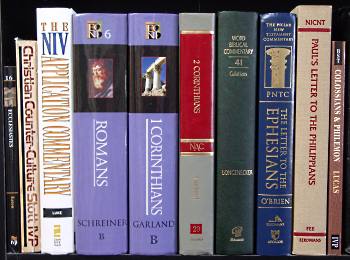
Students of the Bible do well to familiarize themselves with several reliable Bible commentaries. A good Bible commentary will draw out important details within the passage under investigation. Within the pages of a biblical commentary, one may find a conversational partner, a friend, and a guide. One of the difficulties is knowing where to start and which commentary to pick up. Some commentaries are more helpful than others. 

Best Commentaries offers reviews of individual commentaries. The website also provides details on upcoming commentaries and commentary series. A good way to be introduced to important works on a particular book of the Bible is to click on the "OT Books" or "NT Books" tab and select the book you are interested in. The website will display a list of commentaries and a rating. Some commentaries will also receive a tag that describes the commentary as technical, devotional, or pastoral.

Monday, January 30, 2012

How (and why) to Use a Bible Dictionary

A Bible dictionary is one useful tool that readers of the Bible can use to help them in their understanding of particularly confusing passages. A Bible dictionary does for the Bible, what Merriam-Webster or Oxford English dictionary does for everyday speech-- it explains what a particular word means or refers to. When reading the Bible many words might appear that may not be familiar (who of us can profess to have 'grain offering', 'covenant', or 'Gog' at the forefront of our minds on a regular basis?). This is where a Bible dictionary can be of great service. 

Take for example Ezekiel 38 and 39. The editors of the English Standard Version (ESV) have titled his section, "Prophecy Against Gog". Ezekiel 38 begins with God commanding Ezekiel to prophecy against "Gog, of the land of Magog, the chief prince of Meschech and Tubal". If this was covered in my third grade Sunday School class, then I must have been asleep at the time. I do not know who (or perhaps where or what) a "Gog" is. So, I consult a Bible dictionary. 
  1. Choose a Bible dictionary. There are many Bible dictionaries. Some will use a lot of Greek and Hebrew (making it less accessible), but others will not focus on the original languages (or focus on them to a much lesser extent). One accessible volume that is on my bookshelf is Eerdmans Dictionary of the Bible.
  2. Look up your subject of inquiry. So, in our example, you will look up "Gog". In the Eerdmans Dictionary of the Bible there is a brief article under "God, Magog". The article begins with a brief summary, "A ruler and his land or people, portrayed as Israel's apocalyptic foe". A further examination of the article yields a reference to Gog in Ezekiel 38-39 and says:

    "In Ezek. 38-39 Gog is 'of the land of Magog' in 'the remotest parts of the north' (38:51; 39:2). He is the commander who, following Israel's return from Babylonian exile, will invade the land and so provoke a final, decisive battle with Yahweh. The battle between Gog and Yahweh is depicted in the cosmic imagery associated with the Day of Yahweh; earthquake and storm accompany the enemy's demise. Yahweh's victory will at last vindicate his holy name, proving that the Exile occurred because of Israel's sins rather than through Yahweh's weakness" (Eerdmans Dictionary of the Bible, "Gog, Magog"). 

    The end of the article discusses the debate whether Gog refers to a historical figure (some suggestions are given as to what historical rulers Gog could refer to) or to a symbolic figure who opposes the God of Israel. In the New Testament, Gog is mentioned in Revelation 20:7-10 as a distant nation that marches against the people of God, only to be defeated by the God who cares for and defends his chosen people.
  3. Summarize your findings. The context of Ezekiel 38-39 does not require Gog to be a literal commander. In fact, given the promises of God to restore his people for his name's sake in the previous chapters (c.f. Ezekiel 36-37), it is likely that Gog is symbolic of those who have opposed God and scoffed at his ability to provide for his covenant people. With the help of our Bible dictionary, we can understand the passage as being God's promise to his people that there will come a day when all who oppose the people and purpose of God will be defeated.
Many people are choosing to purchase Bible software that may include electronic Bible dictionaries. These electronic dictionaries are fast and convenient (you would use them in a similar way as I described above). For those who prefer hard copies, this means that affordable Bible dictionaries can be found at church bazaars, rummage sales, and used bookstores.