Showing posts with label Biblical studies. Show all posts

Saturday, August 24, 2013

The Canaanite Objection: Clay Jones on the Destruction of the Canaanites

One of the Bible stories that I learned as a child was about the Battle of Jericho. The Battle of Jericho, as told to us then, was tidied up considerably from the way it actually appears in the Bible. The book of Joshua, which reports the events of Jericho, describes things more violently than the cheery tune we sung about Joshua fighting the battle of Jericho. The Joshua account reads (emphasis mine): 

"On the seventh day they rose early, at the dawn of day, and marched around the city in the same manner seven times. It was only on that day that they marched around the city seven times. 16 And at the seventh time, when the priests had blown the trumpets, Joshua said to the people, “Shout, for the Lord has given you the city. 17 And the city and all that is within it shall be devoted to the Lord for destruction. Only Rahab the prostitute and all who are with her in her house shall live, because she hid the messengers whom we sent. 18 But you, keep yourselves from the things devoted to destruction, lest when you have devoted them you take any of the devoted things and make the camp of Israel a thing for destruction and bring trouble upon it. 19 But all silver and gold, and every vessel of bronze and iron, are holy to the Lord; they shall go into the treasury of the Lord.” 20 So the people shouted, and the trumpets were blown. As soon as the people heard the sound of the trumpet, the people shouted a great shout, and the wall fell down flat, so that the people went up into the city, every man straight before him, and they captured the city. 21 Then they devoted all in the city to destruction, both men and women, young and old, oxen, sheep, and donkeys, with the edge of the sword" (Joshua 6:15–21).

This was the beginning of the conquest of Canaan. The book of Joshua continues to report the Israelites’ military conquest of the land of Canaan, a conquest commanded by earlier by God during Israel’s desert wanderings

“When the Lord your God brings you into the land that you are entering to take possession of it, and clears away many nations before you, the Hittites, the Girgashites, the Amorites, the Canaanites, the Perizzites, the Hivites, and the Jebusites, seven nations more numerous and mightier than you, 2 and when the Lord your God gives them over to you, and you defeat them, then you must devote them to complete destruction. You shall make no covenant with them and show no mercy to them. 3 You shall not intermarry with them, giving your daughters to their sons or taking their daughters for your sons, 4 for they would turn away your sons from following me, to serve other gods. Then the anger of the Lord would be kindled against you, and he would destroy you quickly. 5 But thus shall you deal with them: you shall break down their altars and dash in pieces their pillars and chop down their Asherim and burn their carved images with fire” (Deuteronomy 7:1–5).

And God commanded later, when due to Israel’s disobedience in conquering the land they were submerged in Canaanite idolatry and sin, in 1 Samuel 15 (emphasis mine):

2 Thus says the Lord of hosts, ‘I have noted what Amalek did to Israel in opposing them on the way when they came up out of Egypt. 3 Now go and strike Amalek and devote to destruction all that they have. Do not spare them, but kill both man and woman, child and infant, ox and sheep, camel and donkey'" (1 Samuel 15:2–3) 

Clearly this aspect of the account wasn’t stressed in children’s Sunday school. Both non-Christians and Christians struggle to make sense of these passages. Why did God command the destruction of the Canaanite nations? Fervent atheists like Richard Dawkins have seized on these passages and said that the God of the Bible that Christians worship is a fictive, genocidal lunatic. How are Christians to make sense of, and explain, God’s directive to destroy the Canaanites?

Clay Jones, professor of apologetics at Biola University in California, addresses this question in his article “We Don’t Hate Sin So We Don’t Understand What Happened to the Canaanites.” Jones’ argues that (a) we do not hate sin in the same way that God does and so we struggle to understand his directive to destroy the Canaanites (p. 53) and (b) that the destruction of the Canaanites was not an instance of racially-motivated ethnic cleansing but was an act of corporate capital punishment in response to deeply-rooted evil (p. 68).

Jones makes his case by demonstrating from Ancient Near Eastern sources and secondary scholarship that Canaan was polytheistic (or, idolatrous) and that this polytheism was “theologically conducive to (if not motivational for) the formation of Canaanite practices, including the practices of incest, adultery, incest, child sacrifice, homosexuality, and bestiality, such that these practices are not incoherent with Canaanite idolatry” (p. 57). Polytheism in Canaan allowed for all sorts of evil practices that God detested.

After suggesting this connection Jones illustrates the nature of the aforementioned practices in Canaanite life. This is the largest portion of the article as Jones sketches out in vivid detail the morally reprehensible practices of Canaan prior to the Israelite conquest.

Jones also argues that the underlying motivation behind the destruction of the Canaanites was not ethnic cleansing.  God treated Israel, his chosen people, with great severity as well when they turned to Canaanite gods and committed similarly evil acts.

Finally, Jones provides numerous illustrations from contemporary Western culture that illustrate the evil in our own culture is eerily similar to Canaan’s sins. Websites and television promote adultery. Groups lobby for the legitimacy of pedophilia. Children are sacrificed for comfort, cost, and convenience. Pornographic websites featuring bestiality get thousands of hits per day. Our culture, blinded by sin, does not want to recognize the justness of God’s judgment against Canaan because to do so would also be an act of self-condemnation.

Jones sums up his article by writing:

“We do not appreciate the depths of our own depravity, the horror of sin, and the righteousness of God. Consequently, it is no surprise that when we see God’s judgment upon those who committed the sins we commit, that complaint and protest arises within our hearts: “This is divine barbarism!” or “This is divine genocide!” But studying these things over the years has led me to wonder if the Canaanites might not stand up at the Judgment and condemn this generation” (pp. 71-72)
Jones’ article is worth reading, not only because it answers a common obstacle to biblical faith, but also because it calls to our attention a similarity that existed between the people of God in the Old Testament and today. Similar threats to capitulate to the surrounding culture have faced the Church throughout the ages. The Church must resist these, stand firm in the faith, glory in holiness, and be sanctified through the Word so that through its witness many might be transferred out of spiritual darkness and into the light of Christ. Let us pray that the God will protect the Church, strengthen the Church, and use the Church to call the world to repentance through Christ while making the pleasures of serving him known.  

For those who desire a condensed version of Jones’ argument you should consult Greg Koukl’s article on it here (follow the link and download the pdf).

Monday, August 12, 2013

Exegetical Fallacies: Or, How to Avoid Embarrassing Mistakes and False Conclusions

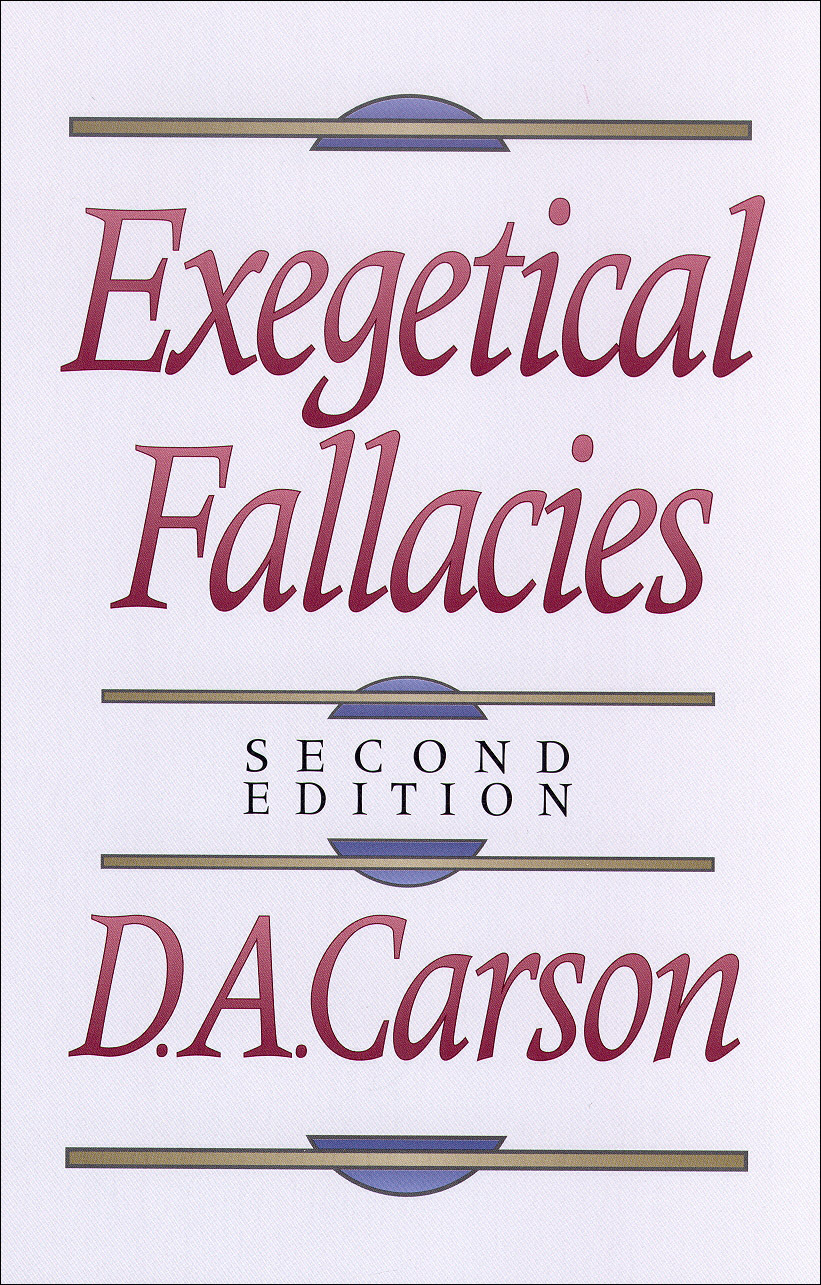
Exegetical Fallacies is one book that has remained on my to-read list for some time. Once or twice I have even picked it up and began reading through it; however, the title rightfully evokes the sense that this is not a book of light reading and so the book remained incomplete for some time. This summer D. A. Carson’s book made it to the top of my reading list again and I was able to set aside the time and mental energy to complete it. It was certainly worth the effort!


Image Source
Exegetical Fallacies is a small, semi-technical book geared towards pastors and seminary students. Dr. Carson, a distinguished New Testament scholar, addresses the numerous ways students of the Scriptures run afoul when doing exegetical work (exegesis refers to the act of finding or interpreting the meaning of a text. Carson provides his definition on p. 23). Exegetical Fallacies gives interpreters the tools necessary to probe points of conflicting when two interpreters of Scripture arrive at contradictory conclusions from a text. When a situation arises where two diligent, sincere interpreters come to opposite, contradictory interpretations, it may be the case that (1) one interpreter is correct and the other has erred (2) neither is correct or (3) both interpreters are partially right and partially wrong, and they must both make changes to their position to better align themselves with the truth. When such disagreement happens, Carson says, “…what is important is that the two interpreters are involved in critical exegesis, exegesis that provides, or attempts to provide, adequate justification of all conclusions reached and of every opinion held” (p. 14). Interpreter must ask what evidence exists to support their interpretation of Scripture. Is there strong evidence to support their conclusions? Could their evidence be stronger? It may be the case that producing such evidence will not resolve every theological conflict, but it will at least allow us to separate the wheat (solid evidence) from the chaff (baseless theological traditions, poor exegesis, or other conclusions arrived at improperly). Exegetical Fallacies exists to shine light upon the chaff, exposing the poor arguments that lead to poor conclusions and in the process strengthening our confidence in the processes that lead to true conclusions and strong convictions. Carson writes, “By exposing our exegetical fallacies, we may become better practitioners of critical exegesis” (p. 14).


Dr. Don Carson
The book is divided into four categories: word-study fallacies, grammatical fallacies, logical fallacies, and presuppositional and historical fallacies. In each section, Carson provides a list of fallacies, describing each fallacy and then illustrating the fallacy in action by highlighting where someone has committed the particular sin against reason in print. The illustrations are particularly helpful to students who should note how subtle such errors can be when inserted amidst countless other paragraphs of written work. They also serve to reinforce the need for a volume such as the one Dr. Carson has produced for us.

Readers should not feel obligated to follow the chapter divisions (I skipped grammatical fallacies and only returned to it when I had finished everything else). Also, the chapter on grammatical fallacies is only useful to those who have an elementary knowledge of Greek. One shortcoming of Exegetical Fallacies is that it does not deal with any issues related to Hebrew exegesis. This would have served to increase the value of an already profitable work for those aspiring to teach the Scriptures.

Wednesday, July 4, 2012

Really Cool Biblical Infographics

For those of you who are visual learners or teachers who like to make good use of visuals, there have been a number of resources produced for teaching the Bible. Tim Challies has done an amazing job producing his visual theology series (remember how the tabernacle points to Christ?). I was directed to this website by one of my former professors. Visual Unit is a goldmine of visual resources.

Here are some cool samples of the resources you can find from Mark at visualunit.me:
Note: Please draw your attention to this request from the graphics' creator. If you feel led to support Mark's work, you can do so here.


Monday, January 30, 2012

How (and why) to Use a Bible Dictionary

A Bible dictionary is one useful tool that readers of the Bible can use to help them in their understanding of particularly confusing passages. A Bible dictionary does for the Bible, what Merriam-Webster or Oxford English dictionary does for everyday speech-- it explains what a particular word means or refers to. When reading the Bible many words might appear that may not be familiar (who of us can profess to have 'grain offering', 'covenant', or 'Gog' at the forefront of our minds on a regular basis?). This is where a Bible dictionary can be of great service. 

Take for example Ezekiel 38 and 39. The editors of the English Standard Version (ESV) have titled his section, "Prophecy Against Gog". Ezekiel 38 begins with God commanding Ezekiel to prophecy against "Gog, of the land of Magog, the chief prince of Meschech and Tubal". If this was covered in my third grade Sunday School class, then I must have been asleep at the time. I do not know who (or perhaps where or what) a "Gog" is. So, I consult a Bible dictionary. 
  1. Choose a Bible dictionary. There are many Bible dictionaries. Some will use a lot of Greek and Hebrew (making it less accessible), but others will not focus on the original languages (or focus on them to a much lesser extent). One accessible volume that is on my bookshelf is Eerdmans Dictionary of the Bible.
  2. Look up your subject of inquiry. So, in our example, you will look up "Gog". In the Eerdmans Dictionary of the Bible there is a brief article under "God, Magog". The article begins with a brief summary, "A ruler and his land or people, portrayed as Israel's apocalyptic foe". A further examination of the article yields a reference to Gog in Ezekiel 38-39 and says:

    "In Ezek. 38-39 Gog is 'of the land of Magog' in 'the remotest parts of the north' (38:51; 39:2). He is the commander who, following Israel's return from Babylonian exile, will invade the land and so provoke a final, decisive battle with Yahweh. The battle between Gog and Yahweh is depicted in the cosmic imagery associated with the Day of Yahweh; earthquake and storm accompany the enemy's demise. Yahweh's victory will at last vindicate his holy name, proving that the Exile occurred because of Israel's sins rather than through Yahweh's weakness" (Eerdmans Dictionary of the Bible, "Gog, Magog"). 

    The end of the article discusses the debate whether Gog refers to a historical figure (some suggestions are given as to what historical rulers Gog could refer to) or to a symbolic figure who opposes the God of Israel. In the New Testament, Gog is mentioned in Revelation 20:7-10 as a distant nation that marches against the people of God, only to be defeated by the God who cares for and defends his chosen people.
  3. Summarize your findings. The context of Ezekiel 38-39 does not require Gog to be a literal commander. In fact, given the promises of God to restore his people for his name's sake in the previous chapters (c.f. Ezekiel 36-37), it is likely that Gog is symbolic of those who have opposed God and scoffed at his ability to provide for his covenant people. With the help of our Bible dictionary, we can understand the passage as being God's promise to his people that there will come a day when all who oppose the people and purpose of God will be defeated.
Many people are choosing to purchase Bible software that may include electronic Bible dictionaries. These electronic dictionaries are fast and convenient (you would use them in a similar way as I described above). For those who prefer hard copies, this means that affordable Bible dictionaries can be found at church bazaars, rummage sales, and used bookstores.