Showing posts with label D.A. Carson. Show all posts

Monday, August 12, 2013

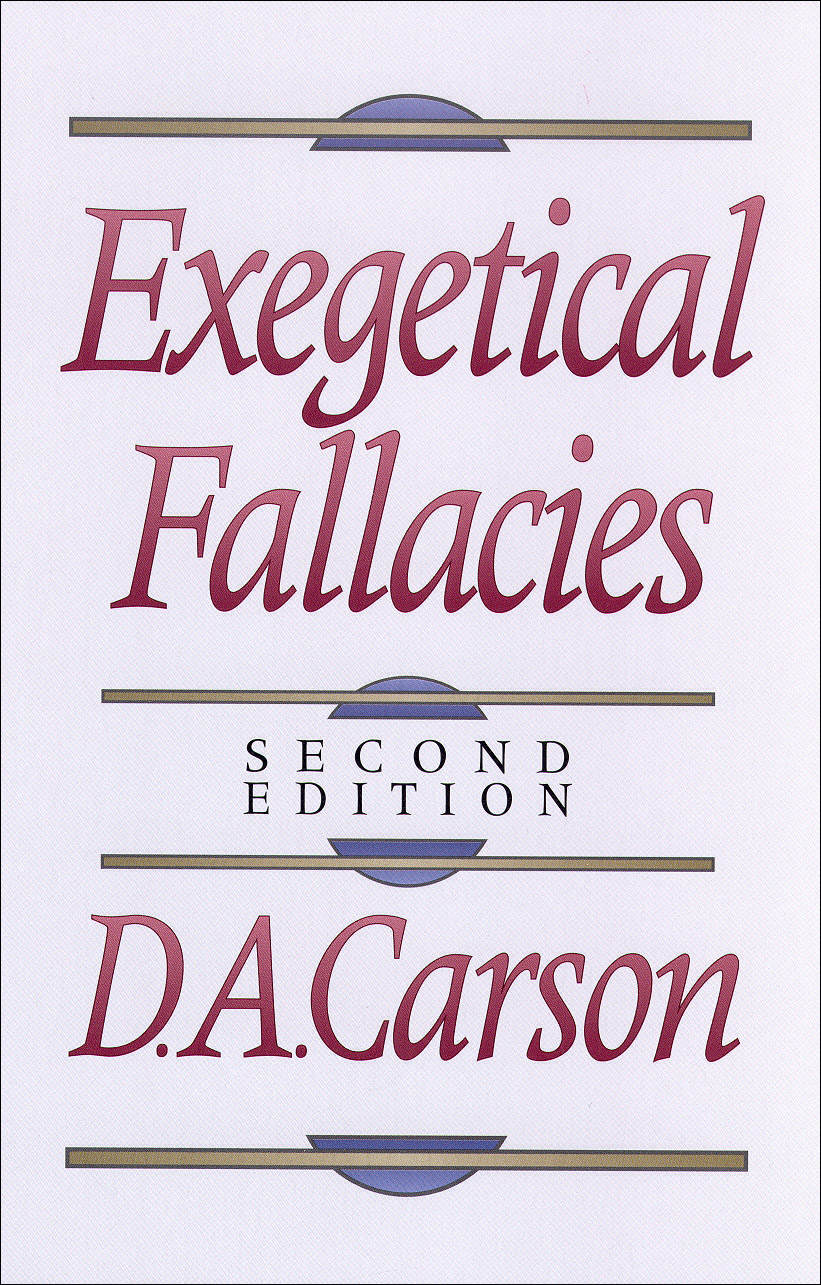
Exegetical Fallacies: Or, How to Avoid Embarrassing Mistakes and False Conclusions

Exegetical Fallacies is one book that has remained on my to-read list for some time. Once or twice I have even picked it up and began reading through it; however, the title rightfully evokes the sense that this is not a book of light reading and so the book remained incomplete for some time. This summer D. A. Carson’s book made it to the top of my reading list again and I was able to set aside the time and mental energy to complete it. It was certainly worth the effort!


Image Source
Exegetical Fallacies is a small, semi-technical book geared towards pastors and seminary students. Dr. Carson, a distinguished New Testament scholar, addresses the numerous ways students of the Scriptures run afoul when doing exegetical work (exegesis refers to the act of finding or interpreting the meaning of a text. Carson provides his definition on p. 23). Exegetical Fallacies gives interpreters the tools necessary to probe points of conflicting when two interpreters of Scripture arrive at contradictory conclusions from a text. When a situation arises where two diligent, sincere interpreters come to opposite, contradictory interpretations, it may be the case that (1) one interpreter is correct and the other has erred (2) neither is correct or (3) both interpreters are partially right and partially wrong, and they must both make changes to their position to better align themselves with the truth. When such disagreement happens, Carson says, “…what is important is that the two interpreters are involved in critical exegesis, exegesis that provides, or attempts to provide, adequate justification of all conclusions reached and of every opinion held” (p. 14). Interpreter must ask what evidence exists to support their interpretation of Scripture. Is there strong evidence to support their conclusions? Could their evidence be stronger? It may be the case that producing such evidence will not resolve every theological conflict, but it will at least allow us to separate the wheat (solid evidence) from the chaff (baseless theological traditions, poor exegesis, or other conclusions arrived at improperly). Exegetical Fallacies exists to shine light upon the chaff, exposing the poor arguments that lead to poor conclusions and in the process strengthening our confidence in the processes that lead to true conclusions and strong convictions. Carson writes, “By exposing our exegetical fallacies, we may become better practitioners of critical exegesis” (p. 14).


Dr. Don Carson
The book is divided into four categories: word-study fallacies, grammatical fallacies, logical fallacies, and presuppositional and historical fallacies. In each section, Carson provides a list of fallacies, describing each fallacy and then illustrating the fallacy in action by highlighting where someone has committed the particular sin against reason in print. The illustrations are particularly helpful to students who should note how subtle such errors can be when inserted amidst countless other paragraphs of written work. They also serve to reinforce the need for a volume such as the one Dr. Carson has produced for us.

Readers should not feel obligated to follow the chapter divisions (I skipped grammatical fallacies and only returned to it when I had finished everything else). Also, the chapter on grammatical fallacies is only useful to those who have an elementary knowledge of Greek. One shortcoming of Exegetical Fallacies is that it does not deal with any issues related to Hebrew exegesis. This would have served to increase the value of an already profitable work for those aspiring to teach the Scriptures.

Thursday, July 25, 2013

The Intolerance of Tolerance

Intolerance is one of those words so widely used, but thought about so little by so many. What makes a person intolerant? What makes a person tolerant? When does disagreement become intolerance? That is why Don Carson’s book The Intolerance of Tolerance is a welcome addition to the bookshelf of any thoughtful observer of culture.

Carson’s book argues that in contemporary Western Culture there are two definitions of tolerance in operation. Previously, tolerance was the acceptance that different views exist (from here on referred to as the “old tolerance”); however, a shift took place so that tolerance came to mean the acceptance of other beliefs. This shift, though subtle, is of great importance. Carson writes:

“To accept that a different or opposing position exists and deserves the right to exist is one thing; to accept the position itself means that one is no longer opposing it. The new tolerance suggests that actually accepting another’s position means believing that position to be true, or at least as true as your own. We move from allowing the free expression of contrary opinions to the acceptance of all opinions; we leap from permitting the articulation of beliefs and claims with which we do not agree to asserting that all beliefs and claims are equally valid. Thus we slide from the old tolerance to the new” (3-4).

The central thesis of Carson’s book is that the new tolerance has become part of the plausibility structure (that is the idea systems that are widely accepted by the culture) of Western culture. The new definition of tolerance has come to dominate social discourse and Carson illustrates many times over how the new tolerance has affected decisions in the realms of politics, education, media, religion, and morality (see chapter two, What is Going On?).   

Chapter three, The History of Tolerance, is Carson’s survey of tolerance in Western intellectual thought. Carson provides historical snapshots that are meant to support his thesis. A change has taken place. It was once the case that the old tolerance was located within the cultural matrix (and dependent upon it); however, the new tolerance became understood independent of culture so that it was raised above culture to be the supreme virtue (75-77). Yet ultimately, when tolerance is detached from the cultural matrix, it becomes a tool for accumulating and exercising control over the populace.

Chapter five examines how the old/new tolerance distinction shapes Christianity. Chapters six and seven explore in greater depth how the new tolerance affects moral and political discourse.

There is a short epilogue (Way Ahead: Ten Words) where Carson attempts to offer counsel for a future where the new tolerance is in full operation. The brevity of this section (one wishes that Carson would have spent more time here) becomes an invitation to readers to think beyond the pages of the book and consider how to navigate the waters ahead.   

Many have applauded Carson’s contribution already. For those interested, you can find more on the book here:

Albert Mohler interviews Carson on his Thinking in Public program. The interview is available in both audio and transcript form.

Tim Challies adds his thoughts here.

Kevin DeYoung listed The Intolerance of Tolerance as one of his top ten books of 2012. 

For those interested you can download Dr. Carson's lectures on the topic online. Go to the linked page and search for 'intolerance of tolerance'.

Friday, April 20, 2012

We Preached Christ Crucified by D.A. Carson

Don Carson, preaching 1 Corinthians 15:1-19, gives a really edifying summary of the gospel. He sets out the gospel in "eight words, five sentences, and an eclectic summary." The summary was so helpful that I have created a summary of the talk in hopes of enticing readers to listen to the full sermon here

Eight Words 
  1. The gospel is christological. The gospel is Christ-centered. The gospel is not bland theism, nor is it impersonal pantheism. "The gospel is not preached if Christ is not preached." The gospel focuses not just on Christ's person, but on his death as well.
  2. The gospel is theological. The gospel is God-centered. God raised Jesus Christ from the dead. God sent his Son to be the Savior. It is not as though the Father and the Son are at odds. The cross and the resurrection are bound up with Christ and with the Father. It is also theological in the sense that the gospel deals with God's wrath against sin. Sin is against God and as a result the gospel addresses judgment. We require God's forgiveness.
  3. The gospel is biblical. Christ died for our sins, according to the Scriptures.
  4. The gospel is apostolic. The gospel is relayed to all Christians by the witness and testimony of the apostles.
  5. The gospel is historical. The cross and the resurrection are inseparably tied together in history. While the credibility of other religions (i.e. Buddhism) depends on philosophical concepts, the credibility of the Gospel is entirely contingent upon historical facticity of the death and resurrection of Christ. If Jesus lives in your heart but not in history, all is lost. 
  6. The gospel is personal. The gospel is not only theological and historical events, but it sets out the way of personal salvation. Any gospel that isn't also personal is nothing more than interesting history.
  7. The gospel is universal. The gospel has a comprehensive vision of salvation (this does not mean that everyone will be saved). The gospel offers the hope of redemption to every culture and corner of creation.
  8. The gospel is eschatological. The gospel is bound up with the "last things". The gospel saves us now and it also prepares us for the new heaven and the new earth. The gospel is also eschatological in the sense that the verdict we shall receive at the end of time is pronounced on Christians already, "Not guilty."
Five Sentences 
  1. The gospel is normally disseminated by proclamation (1 Cor. 15:11). 
  2. This gospel is fruitfully received in authentic, persevering faith (1 Cor. 15:11). 
  3. The gospel is properly disclosed in personal self-humiliation (1 Cor. 15:8).
  4. This gospel is rightly asserted to be the central confession of the whole Church. 
  5. This gospel boldly advances under the contested reign and the inevitable victory of King Jesus.
Eclectic Summary: The gospel has an important propositional or cognitive material (the "news" of the Good News has an important cognitive element). Yet, while we are saved by faith alone, genuine faith does not exist alone. It is always accompanied by a changed life.

The preceding chapters of 1 Corinthians 1-14 are a discussion of the transformative power of God, whereby lives are changed, holiness is exemplified, and the gospel is lived out. The gospel is the transformative power of God.