Showing posts with label Reviews. Show all posts

Monday, August 12, 2013

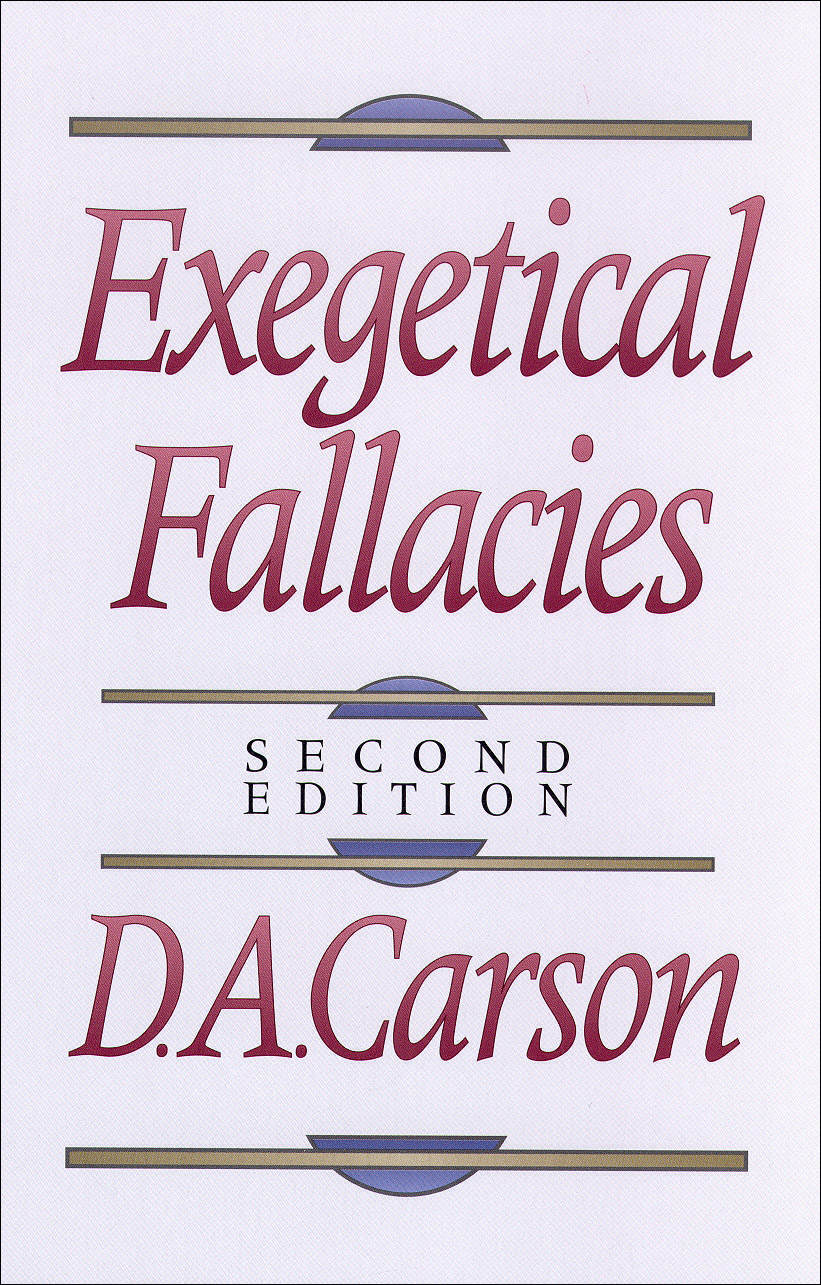
Exegetical Fallacies: Or, How to Avoid Embarrassing Mistakes and False Conclusions

Exegetical Fallacies is one book that has remained on my to-read list for some time. Once or twice I have even picked it up and began reading through it; however, the title rightfully evokes the sense that this is not a book of light reading and so the book remained incomplete for some time. This summer D. A. Carson’s book made it to the top of my reading list again and I was able to set aside the time and mental energy to complete it. It was certainly worth the effort!


Image Source
Exegetical Fallacies is a small, semi-technical book geared towards pastors and seminary students. Dr. Carson, a distinguished New Testament scholar, addresses the numerous ways students of the Scriptures run afoul when doing exegetical work (exegesis refers to the act of finding or interpreting the meaning of a text. Carson provides his definition on p. 23). Exegetical Fallacies gives interpreters the tools necessary to probe points of conflicting when two interpreters of Scripture arrive at contradictory conclusions from a text. When a situation arises where two diligent, sincere interpreters come to opposite, contradictory interpretations, it may be the case that (1) one interpreter is correct and the other has erred (2) neither is correct or (3) both interpreters are partially right and partially wrong, and they must both make changes to their position to better align themselves with the truth. When such disagreement happens, Carson says, “…what is important is that the two interpreters are involved in critical exegesis, exegesis that provides, or attempts to provide, adequate justification of all conclusions reached and of every opinion held” (p. 14). Interpreter must ask what evidence exists to support their interpretation of Scripture. Is there strong evidence to support their conclusions? Could their evidence be stronger? It may be the case that producing such evidence will not resolve every theological conflict, but it will at least allow us to separate the wheat (solid evidence) from the chaff (baseless theological traditions, poor exegesis, or other conclusions arrived at improperly). Exegetical Fallacies exists to shine light upon the chaff, exposing the poor arguments that lead to poor conclusions and in the process strengthening our confidence in the processes that lead to true conclusions and strong convictions. Carson writes, “By exposing our exegetical fallacies, we may become better practitioners of critical exegesis” (p. 14).


Dr. Don Carson
The book is divided into four categories: word-study fallacies, grammatical fallacies, logical fallacies, and presuppositional and historical fallacies. In each section, Carson provides a list of fallacies, describing each fallacy and then illustrating the fallacy in action by highlighting where someone has committed the particular sin against reason in print. The illustrations are particularly helpful to students who should note how subtle such errors can be when inserted amidst countless other paragraphs of written work. They also serve to reinforce the need for a volume such as the one Dr. Carson has produced for us.

Readers should not feel obligated to follow the chapter divisions (I skipped grammatical fallacies and only returned to it when I had finished everything else). Also, the chapter on grammatical fallacies is only useful to those who have an elementary knowledge of Greek. One shortcoming of Exegetical Fallacies is that it does not deal with any issues related to Hebrew exegesis. This would have served to increase the value of an already profitable work for those aspiring to teach the Scriptures.

Thursday, January 31, 2013

The Conviction to Lead

Albert Mohler’s life testifies to his qualification for writing a book on leadership. Mohler was appointed president of the Southern Baptist Theological Seminary at 33 years old. As newly appointed president, Mohler adopted a seminary in theological turmoil (Gregory Wills outlines Mohler’s role in returning SBTS from its theological liberalism to its original convictions in Southern Baptist Theological Seminary, 1859-2009. Wills account of SBTS through the 1980's and 1990's is worth the read) and was charged with leading a seminary that was in decline into the 21st century. This he has done with remarkable success. SBTS is now, from my vantage point, a thriving center for evangelical scholarship and pastoral preparation. 


The Conviction to Lead is an excellent book. Mohler’s thesis is that our beliefs cannot be separated from our leadership. Effective leaders are those who, through every means possible, disseminate their deeply held convictions and set up their organization for preserving and furthering the beliefs they value most. While reading The Conviction to Lead I found myself confronted with activities, habits, and mindsets that I had never thought of as leadership functions. This was a strength of the book. I found my thinking about leadership expanded in terms of what the effective leader does to refine his convictions and advance them, but I also found my understanding of the essence of leadership narrowed to a single point: advancing the beliefs, values, and convictions that I believe are true and beneficial to those I am leading. 


Many have written reviews on Mohler’s book already, so I’ll simply refer you elsewhere for a more detailed walk through of the book. However, I would like to say that this would be a good book for any Christian in a position of leadership (whether in a Christian organization or not), but especially for those who are leading at the local church level. Pastors, elders, deacons, and ministry team leaders will find their understanding of their task made clearer through reading The Conviction to Lead

For the Mohler's own introduction, see his article The Conviction to Lead

Tim Challies' review can be read here. Of the book, Challies writes that this is probably Mohler's best book, "The Conviction to Lead has all the marks of an original work, oozing with wisdom and dripping with passion." Colin Hansen's here. Also, you'll find it on Kevin DeYoung's list of the best books of 2012.

Wednesday, February 22, 2012

The Deep Things of God

The Trinity is central to the life of the Christian and yet, so little is done with such a central doctrine, that many believers are left wondering what the payoff is, if there is any at all! It seems that affirming the doctrine and moving on, without so much as a second's thought, is the best-- and most efficient-- way to deal with the subject. Not only is a frustrating intellectual exercise avoided, but many messy heresies (such as modalism) are avoided altogether. There just seems to be no point in troubling ourselves, so long as we can politely nod at the proposition that God is three persons existing eternally in one nature. We are left to conclude that intellectual assent will suffice. 

Fred Sanders' book, The Deep Things of God: How the Trinity Changes Everything, argues against this mindset. How does gospel intersect with the trinitarian life of God? What does the Trinity have to do with our everyday Christian lives-- with how we pray and study Scripture? What implications does the Trinity have on how we think of God? These are questions that Fred Sanders deals with, expressing the conviction that the Trinity changes everything. 

This book is not an extended treatment of the Biblical witness to the Trinity, so much as it is an argument for the significance that the Trinity places in the Christian life, whether we consciously recognize this or not. In this regard, it is not unique in the history of the Church, though perhaps it does stand out as a bit unique for today's Church. Part of Sanders' method of drawing attention to the Trinitarian nature of the gospel (and those whose lives it changes) is to draw on the witnesses of Christians throughout history. Such witnesses include, but are not limited to, Nicky Cruz, Susanna Wesley, C. S. Lewis, and John Flavel. Sanders' point is to show that historically the Church has recognized that the Trinity is undeniably important in defining how sinful human beings can possibly stand forgiven in the sight of a holy God. Yet, while Sanders wants to draw out some of the details of Trinitarian theology, ultimately, he is suggests the best place for our Trinitarian theology is in the background, working to amplify the deep nature of the things of God: 
"We do not need so much to talk about the Trinity at all times to talk about everything else in a way that our convictions about the Trinity are 'somehow... secretly present' in everything we say or do. Our words and works need to be supported by a tacitly Trinitarianism that distinguishes Christ-centeredness from Father-forgetfulness and Spirit-ignoring" (Sanders, 239).
Evangelicals are not unaffected by the Trinity. They are deeply affected, though perhaps it is the case in recent years that such the effect of the Trinity goes largely unrecognized in most of our circles. Sanders encourages readers, "If you trust Jesus to be your salvation, you already know the Trinity. But it's a great benefit to know that you know the Trinity. It's a great benefit to know that you're a Christian because you've received a Spirit of adoption from the Father, a Spirit that lets you call God 'Abba, Father.' The Trinity is lurking in the gospel, just as it is lurking in the life of every believer. This Trinitarian reality is going on in our Christian lives whether we know it or not" (Sanders, 46).

The book is a difficult read, though a helpful one. It would particular be helpful to pastors, professors, and church leaders who want to explore how they can encourage their congregations and fellow believers to "know that they know"-- that they in fact are already engaged in-- the Trinitarian life. 

The Deep Things of God: How the Trinity Changes Everything by Fred Sanders 
Published: 2010 by Crossway Books
Length: 256 pages  

Thesis Statement: "The central argument of this book is that the doctrine of the Trinity inherently belongs to the gospel itself" (Sanders, 9).

Difficulty (out of 5): Four 
Rating (out of 10): Eight
Recommended For: Pastors and Professors; those interested in understanding the Trinitarian nature of the Christian life   
Cheapest Place to Buy: Christianbooks.com is selling it for $11.99 (US)